It’s during the holidays when families tell their stories. The cold and snow (or this year, rain) lure people indoors, silent nights filling with tales of those both present and long passed.
Having recently completed a university course on the military’s role in shaping modern society, I wanted to learn more about the impact war had upon my own family. Over the course of a single one-hour conversation with my grandfather (we call him Nonno), I heard the story I share with you today.
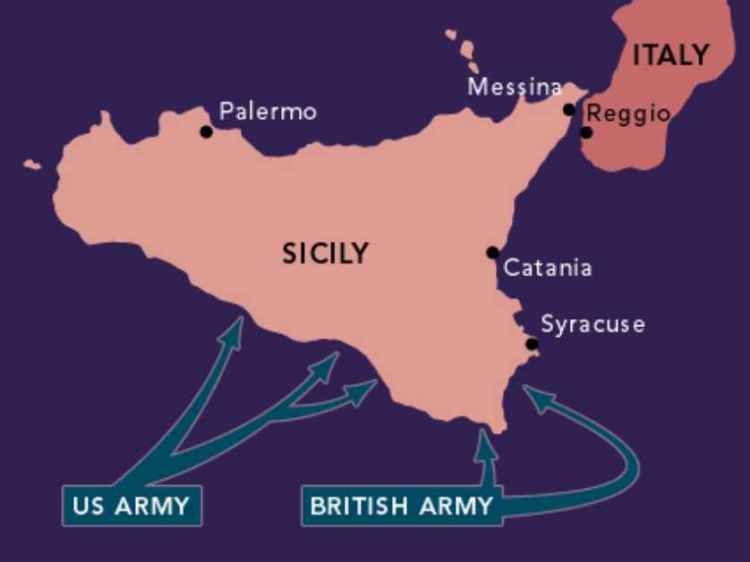
My grandfather was sixteen when Allied forces invaded Sicily.
His North-Eastern hometown of Francavilla, isolated from the combat raging in the South, was used by occupying Fascist and Nazi forces as a transportation hub for arms, food, and materiel. It was the Nazis that my grandfather spoke of as most cruel. They killed women and children who refused to part with scarce rations, and caged residents of entire neighborhoods without food or water in livestock pens watched over by machine-gun wielding guards. Fascist forces accosted my grandfather as he picked oranges in his family’s orchard, demanding to know his age and if he was a defector masquerading as a civilian, a practice which grew more common as the war waged on.
The Allies announced their presence with swiftly-passing planes which bombed transport vehicles and killed nearby civilians with each drop. Despite the carnage, the attacks on Axis supply lines were effective – my grandfather described pairs of patrolling Fascist soldiers forced to share one rifle between them. Fleeing Germans passed through their town towards ships bound for the continent, blowing up bridges and planting landmines in their wake. Nazi reinforcements in the Mediterranean were met by Allied Jeeps and machine guns in their attempts to reach the Sicilian coast.
Frightened of the bombings and German scouts, my grandfather, his family, and crowds of townspeople hid in an abandoned train tunnel in the mountains, leaving its safety only to scavenge for food and game in the hills. A dead man had been sprawled on a sidewalk when the town made its flight; when they returned four days later, certain the new forces they saw in town where Allied and not Axis, the body had remained untouched and rotting.
When the Allies arrived they swept Francavilla for remaining Axis soldiers, finding one Nazi in a countryside shack. The town’s cemetery, used by Axis forces to store drums of gasoline, was set ablaze. Pamphlets were distributed calling for hiding Fascists to surrender at the local church, the crowd that congregated there then taken prisoner. American GIs led POWs on a side road towards an Allied base outside of town. Crossing one of the town’s few remaining bridges, a landmine was triggered and every man on it was killed.
My grandfather concluded his story here, adding that his family was lucky not to have lost anyone or have been solely dependent on rations during that time, having a farm and livestock to supplement the 150 grams of bread allocated to each citizen per day.
He went on to speak of his father, a World War One veteran. Having immigrated to Montreal in the early 1900s, his father answered his nation’s call to arms and returned to Sicily to serve in a volunteer battalion known as the Arditi (“daring ones”) on the Western Front. These troops were responsible for breaching enemy lines, paving the way for a broader infantry advance to follow. According to sources, the Arditi “were successful in bringing in a degree of movement to what had previously been a war of entrenched positions. Their exploits on the battlefield were exemplary and they gained an illustrious place in Italian military history.” They were the most elite force in the Italian army. Some historians consider them to be the modern world’s first true military special forces. Pretty neat.
My grandfather told me the story of the special forces mutiny which arose following a territorial advance that had quickly been reclaimed by the German line. Exhausted and only just returned to camp from their effort, their commander informed them of this news and demanded they immediately return to the Front. A protest followed, the commander quelling it by lining the battalion up and executing half the men at random. The survivors were forced back to the front by their commander, who stood behind them with a pistol trained to their backs. The rest of the unit was killed in a shelling attack, my great-grandfather surviving under the body of a comrade.
On the fiftieth anniversary of the Italian victory in WWI all living soldiers who had fought for at least six months in the war were awarded the order of Cavaliere (knight) in recognition of their service to the Italian Republic, including my great-grandfather.

A sample Cavaliere di Vittorio Veneto Diploma. My great-grandfather’s was issued under the name Antonio Mazza.
I highly encourage you to ask your elders about how war has impacted their personal history. You never know what stories you’ll keep to commemorate for another generation.
This article appeared on BlogUT here.
 The Roaming Homebody